
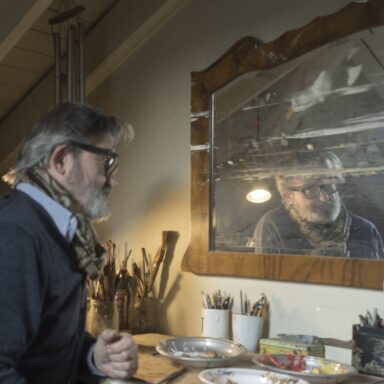
Born in Milan, he trained in Venice, where he lived for six years, graduating in architecture from IUAV with top marks. After his degree in architecture and a master’s in urban planning in Urbino under Giancarlo De Carlo, he chose the path of art, alongside intensive teaching in Colour Theory and Theory of Form at the Faculty of Architecture of the Politecnico di Milano. During that period, besides numerous scientific essays, he published a philosophical essay on these subjects, “Teorie del Colore, frammenti per un’analisi fenomenologica” (Theories of Colour: Fragments for a Phenomenological Analysis). His research has always been oriented towards an awareness of the relativity of the space–time pair. In those same years he was called to Venice by the director of Palazzo Fortuny, who entrusted him with organising a study seminar on “The Usefulness of Art”, a workshop on lighting design, the curatorship of a section (Fortuny’s Light) of the exhibition marking the fiftieth anniversary of the great Spanish artist’s death, and the exhibition design of the show itself. At the same time he worked with Philippe Daverio on founding a School of Applied Arts at the former Istituto Marchiondi (for the Education and Culture departments of the City of Milan). In those years he also curated the following study seminars: ‘Le nuove sinestesie’ with Giovanni Anceschi, Sala del Grechetto, Palazzo Sormani, Milan 1986; ‘Le superfici del design’, Triennale di Milano, with the Chamber of Commerce and Fondazione Ratti, 1990; ‘Le culture dell’abitare’, Palazzo della Triennale, Milan 1992; ‘Telemico e telematico’, Palazzo Fortuny, Venice 1992; ‘Camere con vista’, Abitare il Tempo, Verona Fair, 1993; ‘La qualità dell’Abitare’, Casa della Cultura, Milan 1994; ‘Arte come mestiere’, Accademia di Belle Arti, Bergamo, 1994; ‘Il caso Marchiondi’, Milan 1994; ‘La fondazione di un Centro Studi e Formazione per le Arti Applicate all’Industria’, Palazzo Reale, Milan, 12–16 June 1995; ‘Enti e Fondazioni Europee per lo sviluppo e la promozione delle arti applicate all’industria’, Palazzo Reale, Milan, 1995; ‘La pittura e la memoria’, a series of seminars, Palazzo Reale, Milan, November 1996 – January 1997; ‘L’utilità dell’arte’, Palazzo Fortuny, Venice, 1997. These years also saw his meeting with the great German collector and art connoisseur Franz Armin Morat, who gave him the opportunity to show, at the premises of his Fondazione Morat in Freiburg, a series of large-scale works devoted to the relationship between landscape and horizon.
This experience, which closed the first phase of his artistic work, led to his decision to devote himself for a while to exploring the expressive limits of representation, with photography as his main medium of authorship. For several years he worked as a photographer under the heteronym Henry Thoreau, contributing to some prestigious European publications – above all AD France – and to Italian magazines such as IO Donna, Marie Claire Maison and Interni Magazine. He published several photography books: “Casa Italiana” with Rizzoli NY, “Living Today” with Electa, “Interior Italia” with Mondadori Arte and “Murano, Behind the Glass” with Damiani. In 2012 he received an award for the best photography at the Venice Architecture Biennale. In recent years he has refined his poetic research, using photography to explore the points of contact between the sensible world, forms, the world of primary perception, dreams, and the world of symbolic statements and myths. The most recent episodes of Maurizio Barberis’s artistic work accentuate its relationship with alchemical thought. Here alchemy acts as a catalyst for the material of art – whether photographic material, endowed with its own unconscious autonomy that emerges in its relationship with the author’s psyche, or the dimension of time, treated as a truly ‘malleable material’, much as happens in sculpture or drawing – and finds in photography the art of the instant par excellence: an improbable diachronic variant that calls into question the standardised succession of moments in time as recorded by our consciousness.