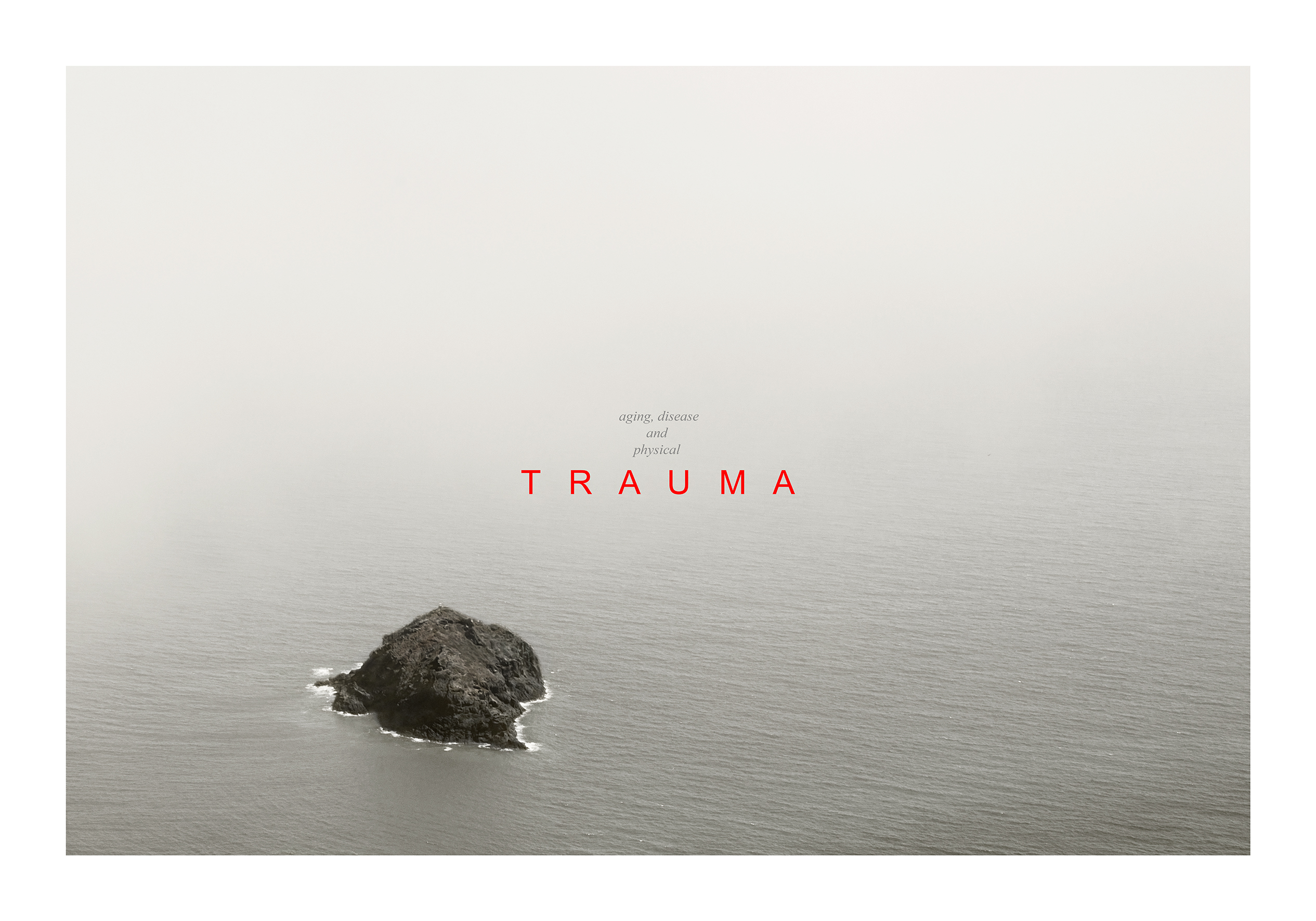
Pierluigi Fresia (Asti 1962, lives in Turin) is a contemporary artist whose photography reflects a frontal gaze turned outwards and a mental, emotional gaze turned towards his own inner life. In his work the author opens two semantic fields and sets them on a collision course: that of the word, as the written epiphany of an unheard-of stream of consciousness, and that of the image, as the icon of a remembering void, full of resonances. His words are born of the necessity that brought them into being; his images are born of the inevitability of the clash with things: their interaction springs from the materialisation and dematerialisation of expectations, set in motion by a desiring machine. By taking pictures that tend to break through space, and inscribing over them words that short-circuit meaning, Pierluigi Fresia never ceases to work on a non-novel, a non-diary, a framework of eventual hypotheses. In a climate of desaturated colour, where the range of greys unfolds between the luminescent whites of snow, the crystalline vapours of fog and the leaden darkness of the woods, every stentorian, rhetorical, lapidary or apodictic effect is constantly erased through a process – a metaphorical one too – of Zeroings of Absolutes. What takes shape is a suspended, silent, muffled dimension of natural and scriptural, spatial and temporal, psychic and sensory multiverses of fluid consistency. A historical antecedent of Pierluigi Fresia’s linguistic signature – he has been active since the 1990s – can be found, with due distinctions and particularly from the narrative point of view, in the international conceptual neo-avant-garde movement that emerged in the mid-1970s under the name Narrative Art, in which photographic practice, recovering a dimension of memory, is accompanied by writing, the two keeping parallel paths that the viewer will make converge mentally into a single expressive moment, thus contributing to the emotional sharing of the work. In the repeated central framings of Pierluigi Fresia’s work one senses the power of cinema over the collective imagination, starting from the announcement of the title, the anticipation of the names that follow, the long shots of the images, the mise en abyme of a story about to unfold. In this artist, as in the cinema of Alain Resnais, for example, one perceives, through temporary spatial, temporal, physical and mental divergences, a journey out and back to the same place, to remember and to forget, to appear and to disappear. Unlike cinema, however, Pierluigi Fresia does not tell a story: he is story, he is present-past-future in an instant – once again, that of the work’s relentless frontality. By insistently adopting a centred arrangement of the representation, the artist himself becomes a source from which branches flow out into an infinite nothingness, into a stream where presence and absence brush against each other and interact without a sound. Memory and oblivion dance in a ring on the surface of words and things, ceaselessly weaving an elegy of difference and indifference. Although he uses frontal framing on the two-dimensional plane of photography, the artist speaks of his own ideal spherical perspective, which offers the viewer a point – not a line – of contact, a foothold for rediscovery or a risk of slipping out of frame, of sliding sideways, without excluding the possibility of a circular return. His framings have a performative quality: when contemplated in sequence they take on the nature of a film cut (as in the fog-veiled landscape with a black dog passing through, dalla verità al vero senza respirare, or in the snowy one of un bambino molto precoce, votato all’adattamento, which sounds like an autobiographical introspection); when observed one by one, they are perceived as a movement towards the foreground and, at once, as a virtual retreat into a fade, now to white, now to black – as in that magnetic, symbolic shot of a night-time avenue with a yellow house at the centre of the perspective, whose unsettling mood is contradicted by the words Everything is al right everyday is like SUNDAY, very much the American way of life. Although at the outset this artist declared himself a painter, his images are never retinal, because it is his personal aesthetic, filtered and pale, that produces the landscape – a landscape made to the measure of its author, which others may share or fail to recognise. In Nel Nome del Padre he builds, step by step, a genealogy that leaves the tree to take shape, from son to son, as a multitude formalised in a triangle with an ever wider base, stumbling on a mound of earth or dark stone that emerges among the blades of grass of a colourless meadow. Pierluigi Fresia has invited the invisible to surface; he has transcribed at the same time the depths and the skin of things. Against reportage, he has set up a device that sinks the links between image and text, creating fault lines of slippage, cracks from which the unknowable can spring, so that the key and the code of identification are lost. To approach the device that produces poetry in this artist, Gaston Bachelard may help – a master, among other things, of a poetics of space from which the Piedmontese artist is evidently not absent either. When Pierluigi Fresia invites the viewer into a spherical perspective, it is to include them in that space of resonances and reflections that Gaston Bachelard calls retentissement, within which readers or viewers feel invested not only with an emotional but also with a creative potential, as if they too were the conceivers and authors of the work. From an encounter/clash of languages springs the twofold dimension, ontological and existential, of being and of the becoming of being. Pierluigi Fresia thus expands his authorship to include the other, the viewer, who is authorised by the artist himself, through the enigmatically open status of the work, to project and read their own story into it. Indeed, it lies in the participatory and transmissive intention of each of his works that this artist does not claim exclusive ownership of them, but consciously chooses to become an occasion for giving and for dispossession. The outcome, however, is that the ontological and epistemological nature of his practice remains recognisable. Pierluigi Fresia, practised in the use of paradoxes and oxymorons (Ricordava tutti gli oblii ad uno ad UNO), first lived inwardly and then generated aesthetically, plays with the relativity of absolutes to the point of suppressing them (Per qualche ora fummo IMMORTALI e ancora nominammo il mondo POI gli dei). With his arsenal of material and immaterial tools he has measured the void and the breadth of drama (Il diametro di una tragedia è approssimativamente un metro e mezzo); he seems to have counted the immeasurable, like sand, the flow of the sea, the length of sleep and wakefulness, the distance of the horizon, the height of desire. He has often suppressed himself in his dialogue with things, letting himself be spoken by sensations without history and without a name. Then, in the thick of the woods he met his imagination, in the clearing his uncertainties, in the desert the presence of his own shadow. A master of linguistic caesuras, of cut-outs of meaning, of abnormal situations, of perceptual and temporal slippages, Pierluigi Fresia has written thought while suppressing its logic, causality and verisimilitude; he has scattered over the field of the work incongruous remains, unanswered questions, paradoxes and oxymoronic forms, outlined between light and shadow, snow and fog, trees and woods, a house, the edges of a road, a still life with fruit and pliers, an absent sea. This artist, whose surname is that of a perennial plant of the Iridaceae family, has never ceased to give form to vertigos of sense and nonsense, writing and erasing an everyday philosophy of being. Finally, by creating situations that cannot be consumed and activating effects of resistance, he has found a surface in which to see himself reflected, a centre of gravity in which to suspend his thoughts one by one.
Viana Conti